


 August 07, 2026

At The Plastic Surgery Clinic in Mississauga, Ontario.
Choosing the right plastic surgeon is one of the most important decisions you’ll make before cosmetic surgery. Asking the right questions can help you evaluate experience, qualifications, and whether a surgeon is the right fit for your goals.
As healthcare continues to evolve, we have higher volumes of people entering the field. This offers diversity in care, but it can also make it hard to choose the right plastic surgeon for you.
When it comes to picking a plastic surgeon, here are some questions you can ask to narrow down your search.
Before you spend time getting into the nitty-gritty of your specific procedure of interest and ‘sussing out’ your doctor’s ‘vibe,’ you want to know first and foremost whether or not your surgeon is board-certified.
There are many standards for education and care, and it’s unfair to expect patients to assess a professional’s qualifications without getting a governing body’s stamp of approval. Board certification ensures surgeons have completed extensive specialty training and passed rigorous examinations.
There are many ‘boards’ that exist to protect patients’ interests, but the one you want to look out for when considering plastic surgery is the Royal College of Physicians and Surgeons of Canada. This national body is responsible for holding surgeons to a degree of expertise before they can claim to be “board-certified.”
After assessing your surgeon’s qualifications on a broad surgical level, you’ll want to determine their practical experience performing your surgery of interest.
If you’re consulting about breast augmentation, for example, ask how many breast procedures your surgeon has performed throughout their career, specifically within the past year. You might also want to consider when they started performing the procedure to get an idea of which techniques they might employ.
With medicine, things are constantly changing. Although all good surgeons keep up with research, you might be more interested in an old-school professional or someone newer to the field.
On that note, it’s best not to assume that just because your surgeon started their career in a particular decade that they’ll employ a specific technique with their surgeries. Ask them about what strategies they use in the operating room and why.
Back to the breast augmentation example… You might want to know if your surgeon uses saline or silicone implants. Perhaps it’s important to you to have an inframammary (below breast) incision instead of a trans-axillary (armpit) one. Does your surgeon insert implants above, below, or in-between the muscle?
Although one surgeon can use multiple methods, it’s important to know their preferred one and why. Is there stronger evidence supporting one technique over another? Does one strategy reduce complication rates down the line? Does the surgical technique impact the longevity of results? Get really curious about your surgeon’s preferences to see if they align with yours.
We have published extensively on results and recovery expectations on this site, but in the end, we make sure to encourage readers to talk to a board-certified plastic surgeon for more information. This is because everybody is different, and the only way to get personalized, professional advice is to talk to a professional, in person.
Results and recovery can vary based on your individual circumstances, and only a meeting with a plastic surgeon can definitively address your concerns. When asking surgeons about results and recovery, you can also inquire about where you can find before and after photos and look into patient testimonials.
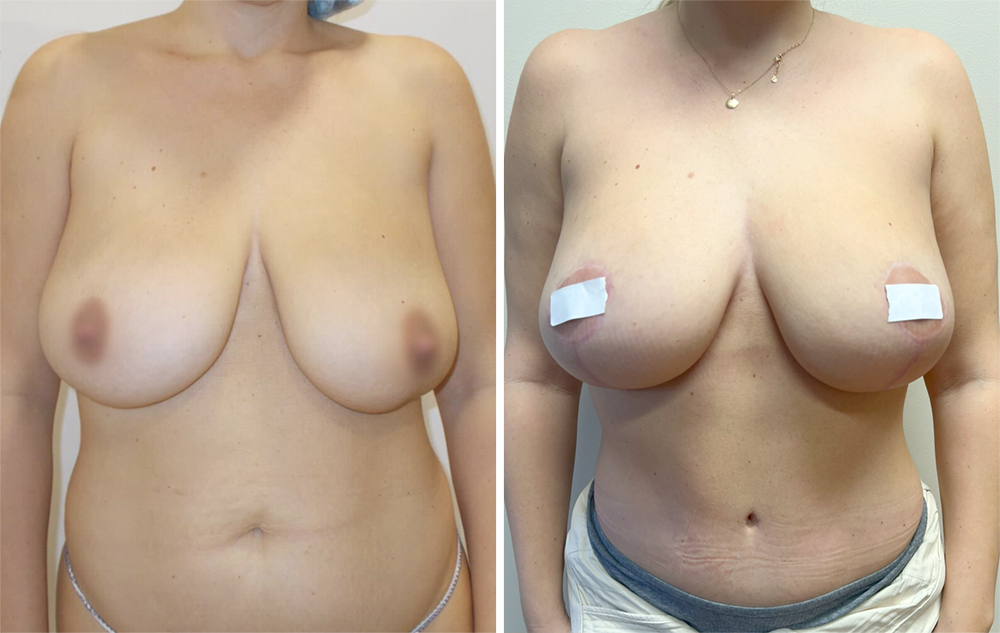
Before & after a tummy tuck and breast lift
This might not be a question you ask your surgeon directly, but it’s a good idea to find what other patients have said about them. You might find plenty of testimonials, or very few… Regardless of the quantity, you want to keep your eye out for quality. 5- and 1-star reviews tend to be more biased (than 3s and 4s), and thorough comments are more helpful than one-liners.
It’s critical to hear and learn from other people’s experiences, but know that it’s not ideal to use online reviews as your only tool for evaluating a surgeon. There’s too much variability, and the truth is, most patients don’t write reviews. So you want to avoid taking comments at face value and instead look for patterns to assess the qualities that you care about (e.g., bedside manner, clarity during consultation, and post-operative care).
Although we don’t like to think about it, plastic surgery comes with risks. It’s important for patients to make informed decisions about their bodies. Part of consent involves clarity about how often things can go wrong.
Along with the rates for complications, you want to consider how your surgeon handles them when they arise. It’s critical to find a trustworthy doctor who can be candid about risks and offers a clear protocol for correcting issues.
In the same vein, you want to inquire with your surgeon about their revision practices in case you are unhappy with your results. After all, the surgery could be a success in terms of recovery, but maybe you didn’t get the results you were hoping for. Maybe you did, but time has passed and things need a refresh.
It can be reassuring to discuss what a revisional procedure would look like in case you become unhappy with your results. Maybe your surgeon will have recommendations for non-surgical interventions to maintain or further correct cosmetic concerns so that another surgery is not even necessary.
This is a deep cut, but you might want a surgeon who keeps their finger on the pulse of the medical field by contributing to research. This means they continue developing their expertise and contributing to advances in patient care, which is great for you.
Evidence-based practice is critical for all healthcare professionals. A surgeon who remains involved in the world of research is more likely to use advanced techniques in their practice. This, in turn, improves patient experience by balancing practical expertise with academic aptitude.
While many established surgeons open private practices, an affiliation with a larger hospital can be a major plus for patients. Some plastic surgery cases require working out of a hospital because of the breadth of resources available.
An affiliation with a hospital is also critical in case of an operative complication where emergency facilities are needed. Surgeons who have existing partnerships with larger institutions are better able to connect patients to a wider network of care.
Once you’ve gotten through the logistical questions, it might help to get to know your doctor a little more as a person. The reason someone enters the healthcare industry tells you a lot about who they are and what their work ethic is like.
Get a sense of which procedures your surgeon is most passionate about performing and why. You might get a lot of insight about how they’ll handle your case and the degree of care they’ll extend during your recovery.
If you’re ready to start asking the big questions, you can book a free consultation with one of our board-certified plastic surgeons today.

Did we answer all your questions? Our goal is to ensure you have the best information possible to make your decision. If you still have questions, we’re here to help.
 416.928.9494
 Email Us